Abraham Maslow’s fourth need: Esteem needs – (i) esteem for oneself (dignity, achievement, mastery, independence) and (ii) the desire for reputation or respect from others (e.g., status, prestige).
(excerpts)
29.01.2023. I had done very little research on Tasmania – but there I was, looking down on the island coming to the end of a four hour flight from Perth although, with all the time lines I had crossed, it was ten hours later than when I left mainland Australia. Even knowing so little about the place, Tasmania is a destination that has appealed to me for a very long time.
I like to arrive in a place somewhat ignorant of what I will find. It allow me to make up my own guesses, ideas and reactions. All those imagined notions and first impressions were going to be added to, changed and informed as I travelled Tasmania in my little, somewhat battered, camper van. I had three weeks here and by day one I realised that that was never going to be enough time. Tasmania, or, calling it by it’s proper Aboriginal name lutruwita, stole my heart the moment I left the camper van hire shop. I was not prepared for my feeling of belonging as I travelled around this island, which is about the size of Ireland. I could live in Tasmania if it was not so far away from Ireland and my life there.
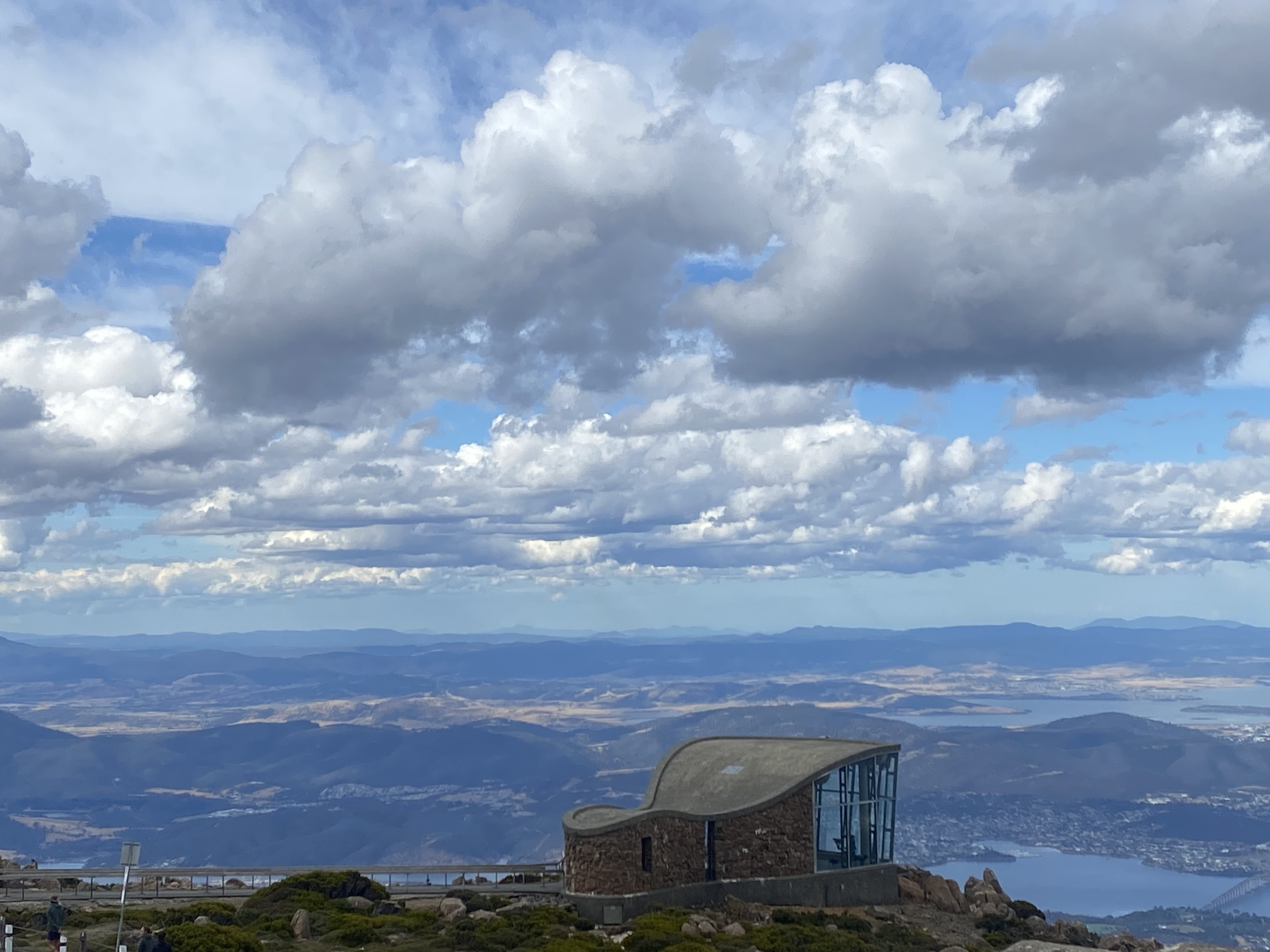
View from the top of Mt Wellington – looking down on Hobart.
Palawa kani is the name of the revived language of Tasmanian Aboriginal people. The term itself translates to “Tasmanian Aboriginal people speak” and is based on surviving written and spoken remnants of the island’s original languages.
The written form of palawa kani uses only lowercase letters. This was a deliberate decision by the Tasmanian Aboriginal Centre to discontinue using capital letters in order to honor the oral nature of the language and to move away from the conventions of written English.

Mount Wellington, also known as kunanyi in palawa kani.
One thing I did do before heading this way, was to make contact with several people who were involved with food production and harvesting from the land. I wanted to explore Maslow’s forth need: esteem – for oneself and the desire for reputation or respect from others through the production of food, for self consumption and growing food for food security.
Thinking about my choice of destination for this topic now, seems a kind of curious notion, in fact, I think I fulfilled a wish of my own to be here by making it my choice to explore a Maslow need. “Like any place where the indigenous people live, lived or were forced to live, most indigenous people do not regard the land as a separate thing to themselves” (p 139, par 3. ‘In Tasmania’ Nicholas Shakespeare).
“The reason there was no word for land was because “we define land as something that is part of us – not separate ” Douglas Mynard. Wilson’s Promontory (1).
The people I contacted I did by cold emailing. It’s indicative of the people who live on Tasmania that they even wrote back to someone on the other side of the world whom they had never met. Their enthusiasm and willingness to help me explore my topic was heartwarming.
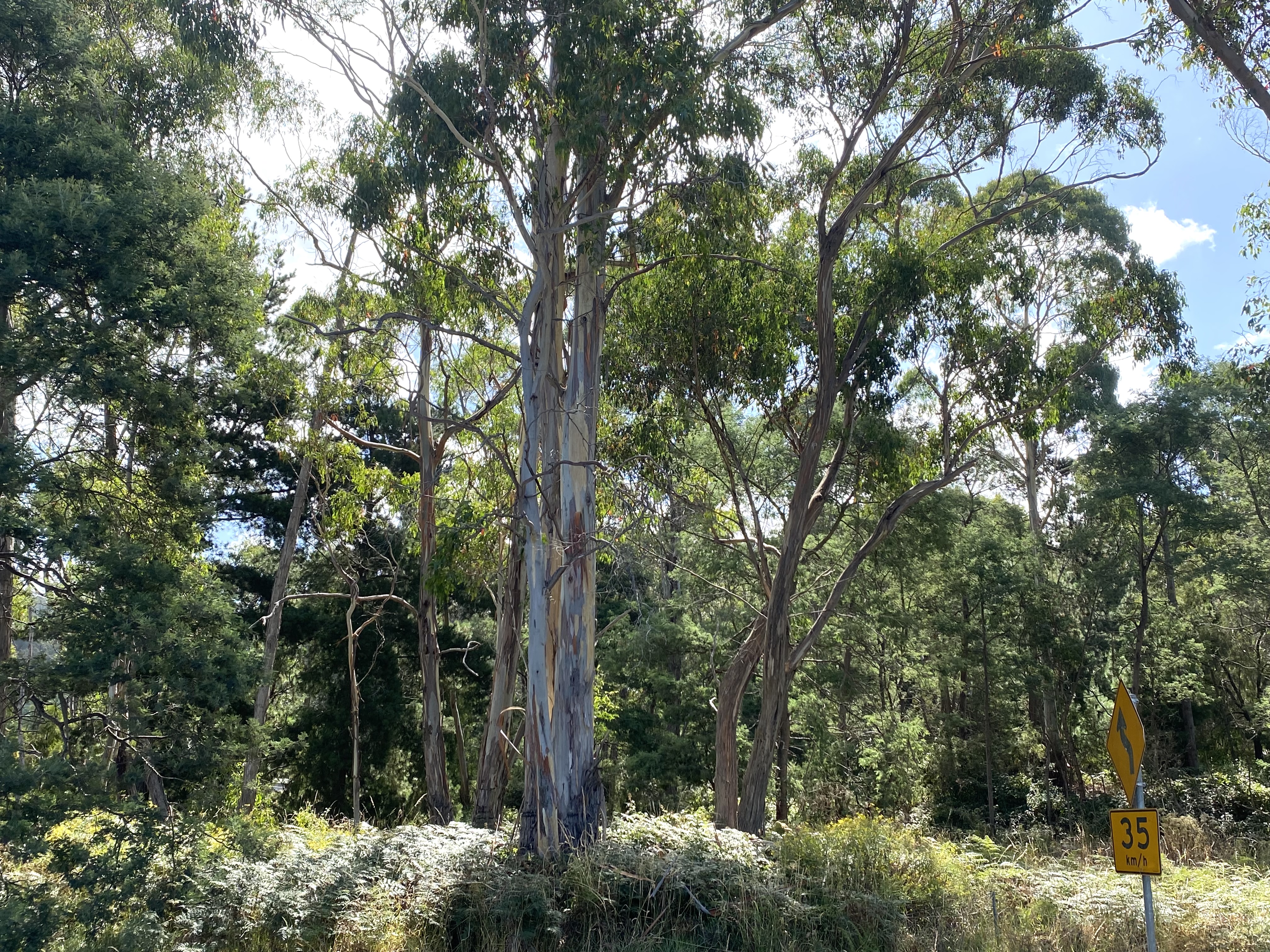
The beauty, the variety of landscape, the openness of the people and the ‘vibe’ I felt, both astounded me and made total sense. Maybe I was a convict here in a previous life or maybe it’s just how Tasmania has developed since it’s long and brutal history into what the island is now. I think too, now that I am finally writing about Tasmania three years since visiting, that Tasmania has been a place of healing for me. It was time for an adventure and to try and start some part of my life anew. I went with the idea of gathering information for a project, but also to just sit at the side of a road in odd places, to just stare, observe or sit; quite within.
Abraham Maslow’s fourth Need deals with esteem and self esteem. Both feelings that could be explored in many different ways but it was through the idea of food security, part food self-sufficiency and the environmentally changing world that I wanted to explore with this ‘need’. I am a keen gardener myself and there is an immense sense of satisfaction that comes from making a meal out of vegetables grown in one’s own garden. There is an enormous sense of self esteem from growing food that feeds people.
In our changing world where food is increasingly scarce in the wrong parts of the globe, and in excess in other parts, it can often leads to food waste and the manipulation of plants grown to produce more for profit than food’s nutritional value. I wanted to take a step back and meet other growers who cultivate along the same principles as I do. In the lands of plenty we are very busy teaching people how to grow their own produce – a basic lesson in survival that many seem to have lost the ability to achieve. Community gardens have sprung up everywhere. I think back to the Backyard Farming project that was started in St. John’s in Newfoundland to counteract the 90% of imported food that is consumed in that part or the world (at my time of visiting in 2018). (https://annabelkonigvisualartist.com/2017/09/19/food-newfoundland/). I was also thinking of the small villages near me at home that are all busy turning sods of earth to teach people how to grow potatoes and other vegetables. The joy of these gardens for those who take part contains such esteem feelings. We are taking control of a part of our lives again, an essential part of our staying alive. It is not just the cost of food from elsewhere, or the air miles, or the methods in which the food is produced – growing your own garden gives peace to the mind, a sense of collective community in our busy, often isolated lives, and it will nourish your body and mind with food that can heal and strengthen.
Arriving in a strange place where, even though English is the spoken language, there are methods and understandings I don’t yet have. I miss the bus to the tourist park where I will be spending my first night as it is too late to pick up the camper van today. I finally manage to get a taxi from the airport and it transpires that my lodgings are only about three miles from where I landed. The Hobart Airport Tourist Park is not quite what I thought it would be. The office closes at five pm and so I find a little box with several envelopes inside. One has my name on it and a key to ‘chalet no 1’, I am to let myself in. There are no shops nearby apart from a petrol station selling nothing much that resembles real food. Opting for the only vegetarian roll and a big bag of crisps to add some flavour to what I know already will be a tasteless meal, I walk back to enjoy my dinner. It is ten to nine at night; with all the timelines crossed my body clock is completely off. This holiday park is very much for people with trailers, caravans and of course a car. Each car currently parked here, seems to be white – is this to do with heat? My accommodation is basic but clean. The bed is stacked with pillows of various sizes and the mass produced artwork is glued, crookedly, to the wall. I am so looking forward to getting my mobility tomorrow and so see places other than this.

Blue Gum Road.
31.01.2023. I have slept in three different places over the past three days. Tonight is my first night in the camper van. There are several things that don’t work, one of them being the fuel gauge “but, if you refill every 400 km, you should be fine” the man from Devil Campers tells me. There are items in this van I am not familiar with such as the cooking stove. The gentleman raced through instructions at such speed and jumped from one object to the next that my head was spinning with too much information and not enough understanding. The stove, as it turns out, does have a knack which I finally, after several days of cold food, thankfully manage to discover – I can now make coffee!

I have had a full day. I crossed the Tasman bridge four times as I kept missing my turn off. It made me laugh as over and over I went. Not having a map and my google maps not working on the network I am connected too, resulted in this repeated error. I only had a very vague idea of where I was and which direction I should be heading in. My first, accidental stop – was the Botanical Gardens. Botanical gardens are always on my list and so worth spending time in.
The garden is big but not huge and houses a broad range of trees, flowers and sit down areas and of course a gift shop and cafe. The place is busy. I buy a book on Tasmania, full of maps and information, and take my brought lunch to sit under the shade of a tree that overlooks much of the gardens. It is quite a lovely place. I feel a calmness come over me as I watch people explore. A wander leads me to an area with vegetable, which, of course has to be part of a Botanical Garden.
The information leaflet reads: ‘Within the Botanic garden is a vegetable and fruit area. This has been a site of continual food production for over 200 years. It started in 1806 as Hangan’s farm and became a productive Government House garden and orchard for may years. The area then became an economic garden displaying food and crop plants, but it was a 90’s television program that made it famous’.
‘A section of the garden was made into ‘Pete’s Patch’ in 1995 by famous gardening Guru Peter Cundall as part of the nation program; ‘Gardening Australia’. The garden is still used for filming sets and with a team of dedicated volunteers, much of the produce grown there is distributed through various community charity programs that help provide people in need with healthy, free or low cost meals’.

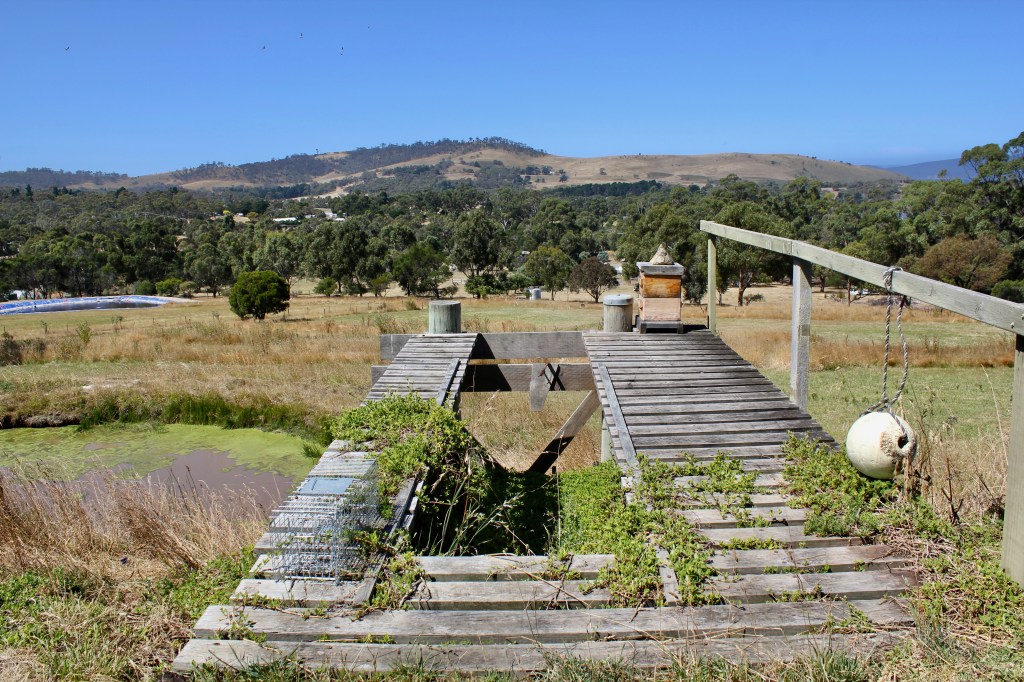
05.02.2023. Today I have a place to be. With a prior arrangement via email, I have ended up at a small seed saving business some miles outside of Lauderdale. There I had an amazingly interesting talk with Kate and Flo who own Seedfreaks. It is always interesting to meet people who have completely changed their careers. Kate used to be an opera singer. When one thinks about opera singers, Kate is not what would be called typical. She is a slight slip of a woman. She met Florian who is an ergonomist. He hails from France and also spent time in Germany as a child. He has worked all over the world and after graduating with a degree in agriculture, spent five years working as a farm manager at various farms in various countries, all the while building his knowledge. He also did a stint in Tasmania and always vowed to come back and live here. I guess his dream has come true. I asked him why he had chosen this line of work and he told me that one of the reasons was, when they moved to Germany after France as a child, both himself and his sister were so dismayed by the quality of the food that they decided to do something about it. Both now work in food production.
I spent four hours with these lovely, enthusiastic people. Their house is filled with a wide range of personal belongings in piles around their kitchen/living area. Perhaps it is about rearrangement or nesting as they are expecting their first child in four months. Flo tells me about the soil in both his garden and the places he visits as part of his off-site job. There is a big problem with salination and arsenic in the water. He encourages the planting of more native plants that were always good at preventing this. As land is reclaimed and changed for an expanding population, the clearing of these native plants is having an effect. The levels of these problematic minerals is amplified if land is tilled. At Seedfreaks they use mostly raised beds from compost that they make themselves, this helps, but at times, Flo tells me, he can taste the salt in the lettuce. The subsoil is not far under the top soil in this area and plants often struggle. Flo and Kate’s best compost they say, comes from a mix of straw, hay, cattle manure and bark chipping. They have two bulls who provide some of what they need. These bulls are more pets, living their good lives rather than functioning as breeding males. Spring comes earlier here than on the mainland and the food produced is of a high quality. I have seen many signs saying ‘Tasmania – the culinary isle’ and I have passed many places selling local cheese, wine, meats and vegetables.
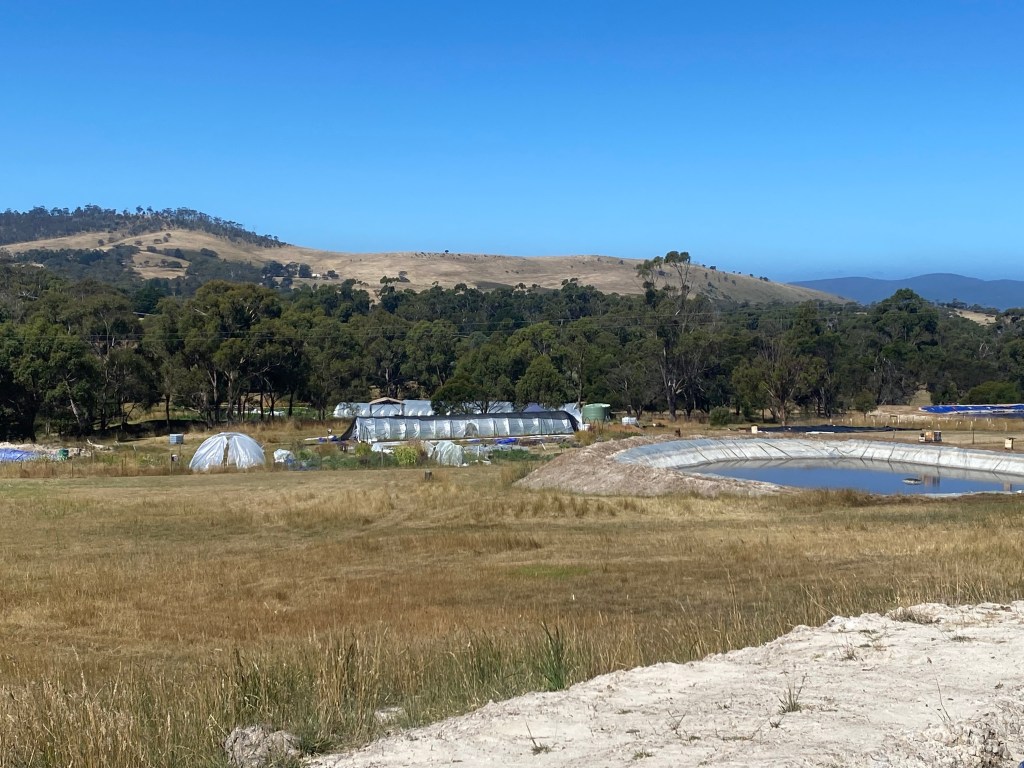
They tell me that the best of the produce will be exported to China and then the mainland, leaving the less good stuff for Tasmania. They mention that people here either won’t or can’t pay the price of the premium produce. The wages here are also lower than on the mainland but the cost of everything is going up. They used to grow fresh crops and sell to the local supermarkets but again, the produce was too expensive for the locals. Their lives are about to change with the coming of a child and they have done some forward planning and now concentrate on seed saving as their commercial income. They do grow fresh food for themselves and are experimenting with plants for their drought garden. It is an idea I would not have readily thought of but then I live in Ireland and water is less of an issue at present. They are also working on producing a compost of sorts which is biochar. This means that by adding charcoal the soil, it holds on to more of the water that is available and slows down the water’s release. Flo also spends quite a few days of the week off farm, working as a soil advisor, so that also helps to keep things going. They have only been here for two years and have in that time improved the small holding greatly. The seed saving business is just one years old and they are expanding their clientele all the time. There are water-ponds for the plants and the house and a vast network of sprinklers and a fire protection system in place with two dams up on the hill behind the house in the forest for spraying; should fire become an issue. Like many, I would imagine they have their emergency bags ready to go, these are organised people. The living quarters of the house is above the bedroom and garage area and through the kitchen corner windows you can look down on the flowering fields to the blue sea.

As I get the tour of the gardens I take in all the plants they are growing and for a moment forget that they are in the business of seed saving. The plants I look at are either ready or past harvest and bolting. Exactly what they need. This place has a method and organisation quite different to what I have seen. There are five water ponds, four meters deep (there is less evaporation if a water body is deep rather than wide), and four large green water tanks. The plants are grown on compost with vegetables and flowers mixed together which helps with pollination and there are plenty of insects buzzing about, plus a snake area. I didn’t see the snake but was warned about this patch – I took a wide berth.
Their harvested seeds are kept in an insulated metal shipping container, which is kept at a cool temperature. They have a section of ‘spare seeds’, ones they won’t sell as this is the crop for next year’s harvest. The cool, refrigerated container has bags and boxes of seeds on shelves all the way round with the names of plants I recognise and some not. There is enough seed here to feed the whole of Tasmania, it is impressive. Their office is another shipping container, in fact, the use of shipping containers is quite common here, I see them used for a wide range of businesses. This office container is clad in plywood and the large windows and sliding doors look out again over the grassy fields, trees and shoreline below. The two bulls are grazing peacefully.
Kate is vocal about her frustrations with some of the locals’ mindsets regarding agriculture but she has the conviction that what they are doing is important work. It is. Who else is thinking about drought resistant plants or saving seeds that are native to this area of Australia?
I leave these lovely people and their interesting farm to mull things over. So much information to write down and consider. Some day it would be good to go back and see them again.

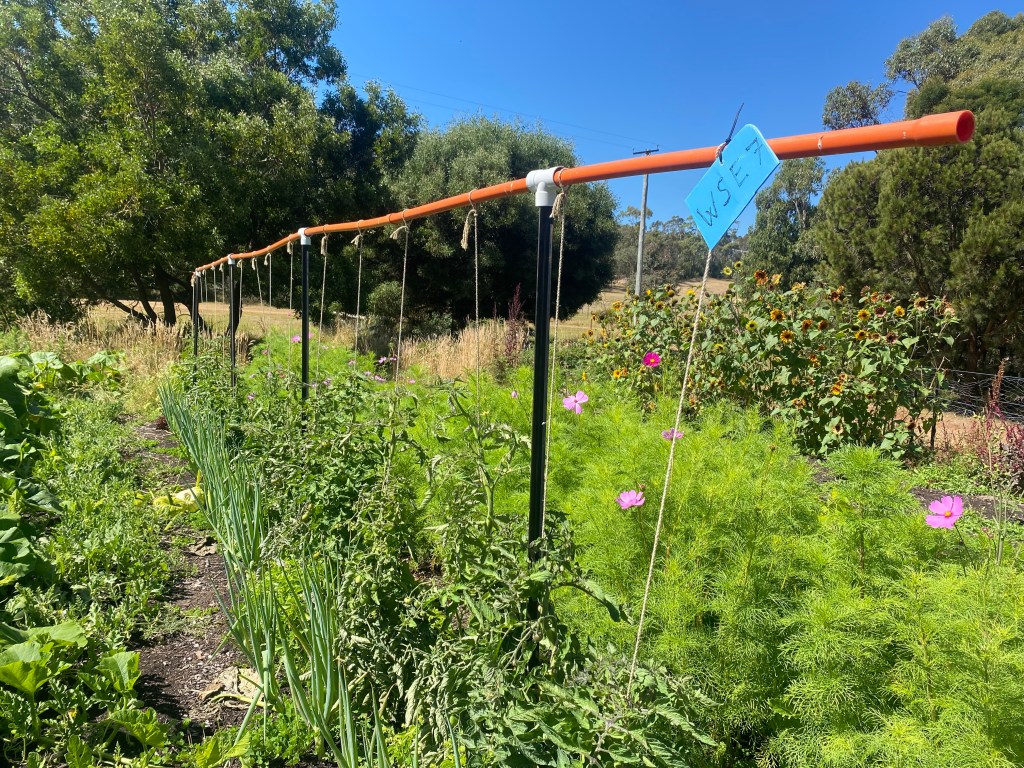
06.02.2023. I am heading back towards Hobart to visit a community garden in the city. 24 Carrot was set up by the MONA people. This original base in Bridgewater was set up six years ago and used to be a small garden centre so at least the soil had been looked after. I am given a tour. The aim of the project is to encourage and educate people how to grow food with an emphasis on school aged children. Many of the classes are also linked to the school curriculum and so some funding comes from the Land Council. Not only that, they also have a chef (the current one is of Russian decent), on the payroll, who gives classes on how to cook the food that is grown and, to top it all off, a pottery workshop where big and small can make their own crockery from which to eat off. There is a long table in the garden made from a plank of a fallen tree. Here extended lunches of the grown and prepared food is shared and conversations are had. Catherine Woo, the lady who is showing me around, says that this is where you can see the sparkle come into the children’s eyes. There is no cost involved for the children to be here. What a brilliant idea.
The garden is large and very well managed. The variety of food grown comes from the fruit trees, the veg beds and the area of Aboriginal bush tucker. They make their own compost and seed save and everything is done for the local community. Bridgewater is labeled as being an area of ‘disparity of wealth’ in the city of Hobart, still, the neighbourhood looks well kept and clean. There is a new building going up at the garden: ‘The beauty lab’, which is going to house a workshop for cosmetics, all made from what is grown on site. The idea is so that it might offer a way for people to set up their own businesses and offer a job away from the current unemployment that is high in this area.
I imagine what could be done in Ireland if there was some form of investment into community gardens and a different way of living for people. The advantage here in Tasmania, of course, is that the weather is better. 24 Carrot also has schools that they fund in other parts of Tasmania, one is in Launceston which I will be visiting anon.

I leave the 24 Carrot garden in the early afternoon and head towards Richmond. The roads are empty outside of the city, just me, tooteling along. I stop in small towns and wander about. The landscape of flat plains on my drive are full of sheep; they melt and disappear into the white, long grass.
I see: butterflies brown and white, dragon flies,black swans, a sign that says 26km to White Giants.
07.02.2023. The heat is intense and my feet are sweating. My destination is a spot outside the town of Swansea where White Giants (trees) are marked on a map at the information stop. BTW, these information stops are everywhere with local info and suggested trips. I drive and drive and follow the signs for these trees. The area has been freshly logged and so is not the most attractive. Then the signs stop and I have no idea where I am, there is no phone signal either. I make a guess and follow the worst road I have driven in a long time. I crawl the van through ruts and dips, boulders that could do big damage and with the lack of signal this is not a time to breakdown. The remaining, standing, thick forest has tracks with fences and people’s names on them, people actually live here and drive this road frequently. Their vehicles are probably more able. I consider turning back but I don’t. I make a quick calculation as to how much drinking water I still have onboard. I persevere. Finally I see some blue light of the sky peeking through tree tops and I know I am coming to the end of this Red Riding Hood forest. The road suddenly plunges downwards and I am among green fields with Black Angus cows. I stop and make a coffee, just to that I can look and admire and laugh at the madness of that non road.
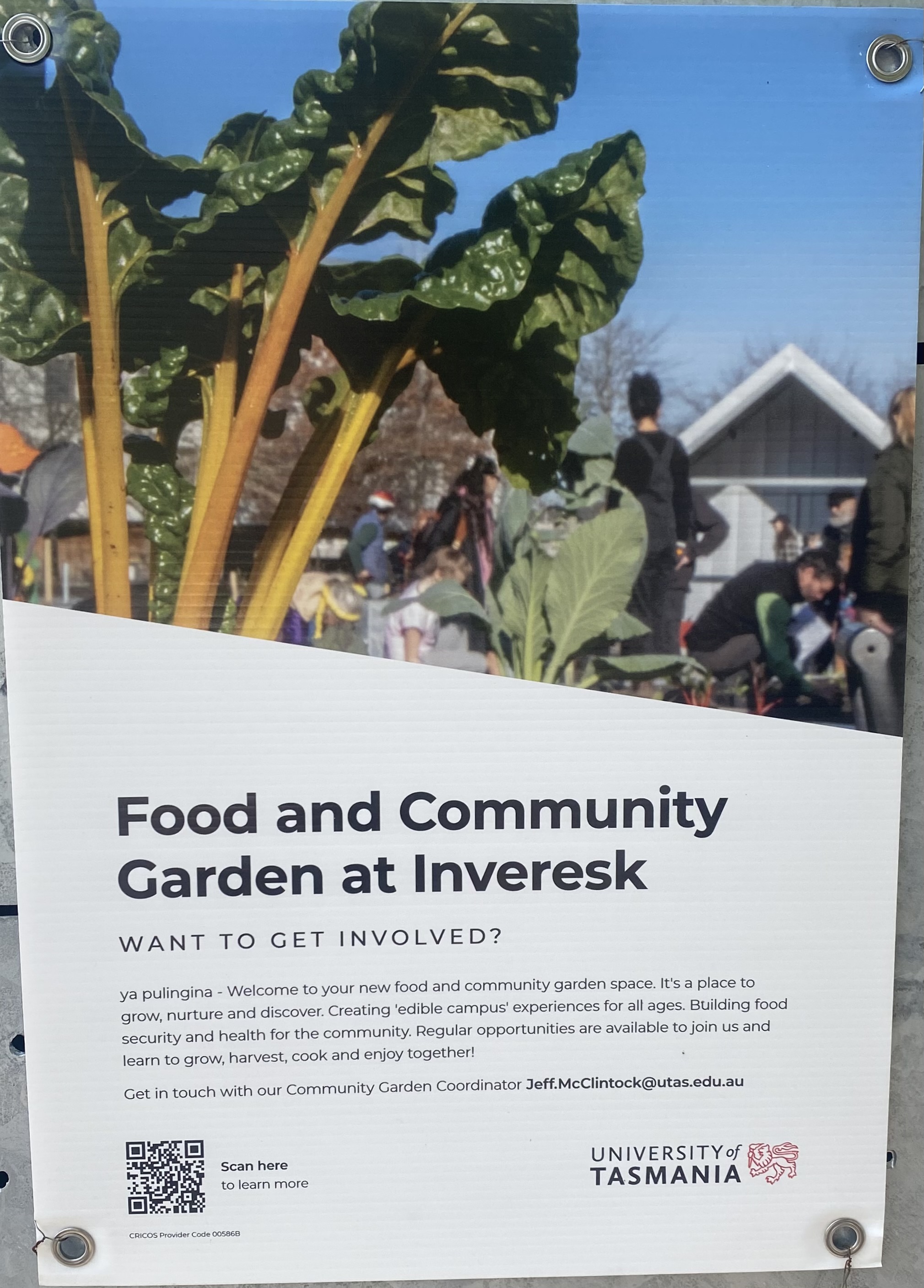
10.02.2023. Launceston is, like Hobart, a sprawling place, hills and houses for many miles, or so it looks as I enter. The feel of the city (Tasmania’s second largest), is better, more substance that just tourists. Much arty stuff, the uni, and amazingly right in the centre of the city, there is an, open to all, Community Garden. The school in a suburb of the city is where I meet Jo Dean, the Northern co-ordinator for 24 Carrot. It has the same kind of set up as the one in Bridgewater, Hobart.
This school also receives state funded and has a strong emphasis on philanthropy. There are five school in the Northern area that come under the 24 Carrot scheme. This garden is now in it’s second year and it was designed with input from architectural students from the university. The food garden is much smaller than the one in Bridgewater but it has to be as it is within the compound of the existing school grounds. The children here are also from less advantaged areas and very diverse in their ethnic backgrounds. Like in Bridgewater, the pupils learn about food, have cooking classes and also a pottery studio where they make their crockery. ‘It is such a good idea to have this triangulated approach, so why not roll it out wherever 24 Carrot is? says Jo. This method also falls nicely in line with the Gardening Northern Tasmania scheme, which includes community gardens. The emphasis is that if you are in control of your food system, you become more self reliant, eat the good food that you like to eat and try to grow food that will survive it’s climatic environment. People come for all kinds of reason to community gardens as it becomes a place to meet people if you are new to the area. It becomes ‘an experience’. The many nationalities all bring with them different ideas, recipes and points of view; not just on how to grow food to live. People bring their stories and their cultures. These gardens and the sharing meals get togethers, represent the stories of those people. Within this open attitude there is a programme here at the school, where women from many cultures come together to cook, eat and converse. Although a smaller garden, it is amazing how much food can be grown. These lucky children will learn as they grow.


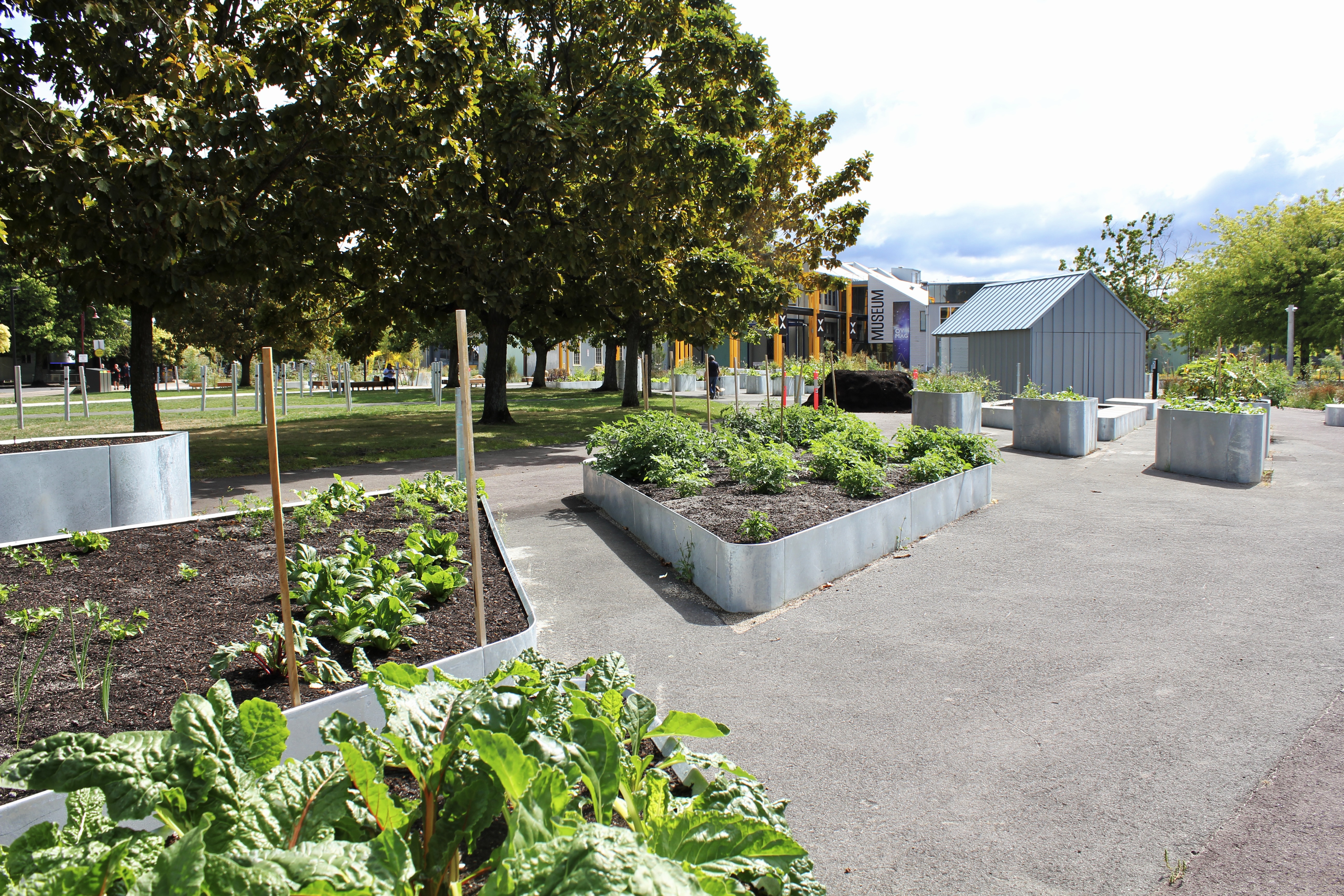
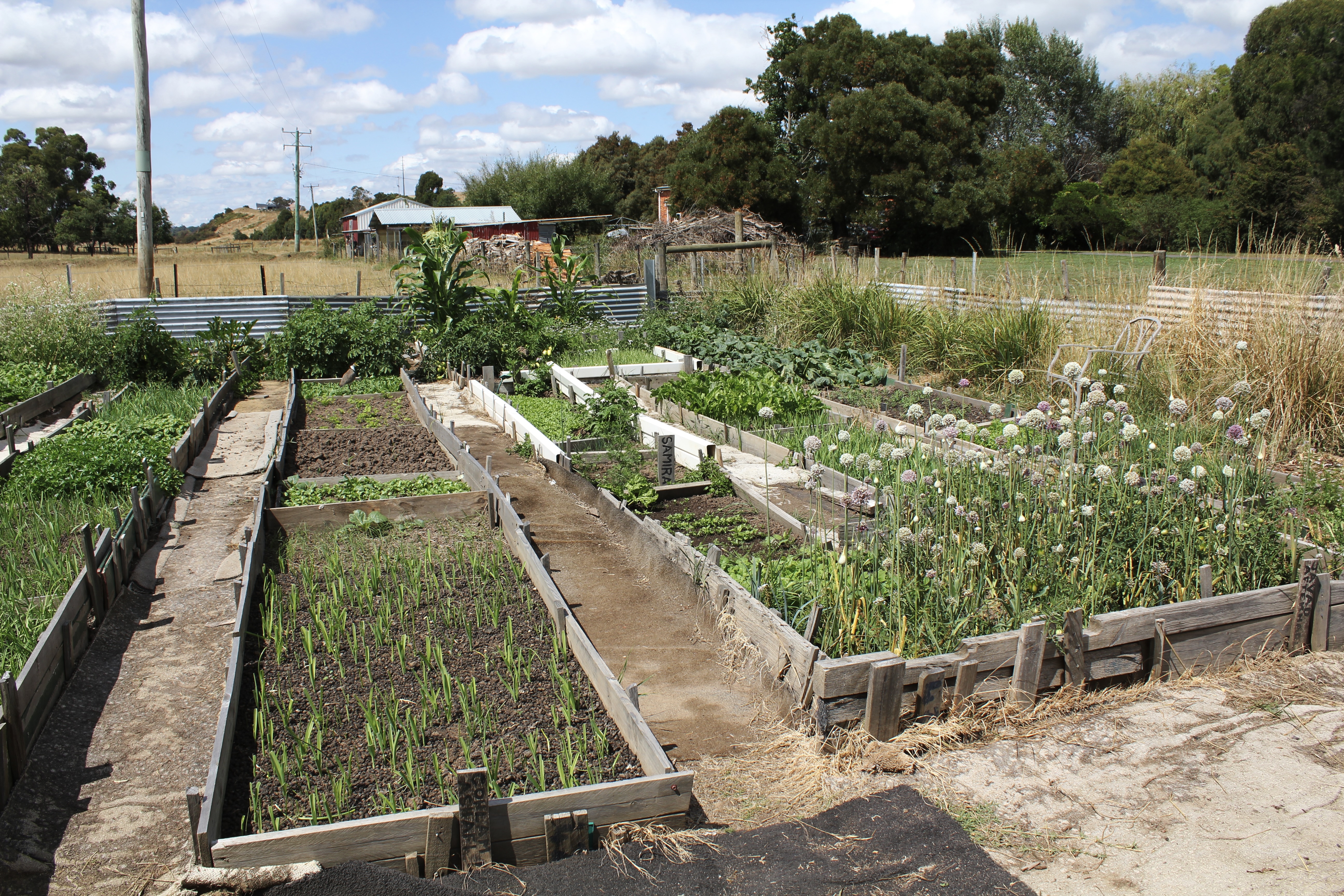
Jo was really kind to give me nearly three hours of her time to drive around, hence I saw something of the city. We visited various community gardens, set up at various locations and run by one paid manager and volunteers. The system here seems to be to ask the people what they want or need. The range of nationalities, all housed close to each other for support and community building, in turn, leads to the gardens where the people grow food from their homeland and to cook the foods from home. It allows for integration. It makes for a more settled and happy communities for those living in the areas for this generation and those who follow.
It’s hot today. We sweltered from one garden location to the next. Jo shows me a garden that is part of a community centre where food is grown in high, oval corrugated soil beds. This area is mostly where people from Afghanistan have been housed and so they grow the plants they grew up with. We travel on to see a garden with gardeners from South Sudan. The locations of each garden is different. One is by the side of a rail track, one behind a pastor’s house on a back garden that used to be just lawn, one is enormous and even has a house on it which now acts as a coming together space. This last one is very impressive as it has a poly tunnel and separate sheds to house equipment and whatever else needs housing. The beds are in vast numbers and divided into family plots. The sweetcorn, or Bultaneese corn, is growing tall, taller than I am familiar with and Jo explains that the seeds have come from the gardeners original country. The fact that so many of these plants come from places hotter than Tasmania and, with the changing climate and increasing temperatures, could mean that the plants are better able to adapt? It reminds me of Kate and Flo from Seedfreaks who are working on drought resistant plants. The gardens are becoming connectors.
Our final stop is the community garden by the university in the centre of the city. The high beds are made of shiny steel and reflect both the heat and the strong light from the sun. The paved areas bounce the heat from below you so it’s hot all round. As this is the main face of the uni, the garden must be beautiful and maintained but also include diversity and perhaps form a testing bed of what crops will survive. The gardeners themselves live in the tall apartment buildings close by and again, come from a large range of countries. There is an art centre/workshop within this open, city space with colourful murals. It’s the kinds of place that appeals to me. Tasmania is also a GMO free island.
All these areas have citizen councils so that what the people would like can be integrated into policy and development. Jo and I talk as we drive from place to place. I write as fast as I can into my notebook as she speaks. Jo gives me ideas of where else to research, names of artists, council policies, places to see and her wide, years long experience of working with nature and social integration through food. She also asks me ‘if you could live here, where would you live? I don’t have an answer for that yet but it is a question that comes to me many times on my trip. She also offers me a job.

11.02.2023. The smell of the trees. I see: foxgloves in pink and white, ragworth and fields of daisies. Herds of Jersey cows, two tone cows with their stripe going from shoulder to rump. In Meander I come across a large shop fridge that has been repurposed as a free book depositary. The air, strangely, smells like salt yet I am far from the sea. I am so not in a rush today. It is 9:30 and I have barely gone five miles.
I see: houses with high stacks of wood ready for the colder season, dairy cows and huge organised farms, fodder neatly in rows, large sheds, old, abandoned, wooden houses; some have wattle and daub. Road kill, vernacular and modern architectural buildings, big trees and big vistas. Postboxes at private houses that are like works of art. Law abiding citizens who greet me from their cars. Sheered sheep, cottage gardens, large areas of land with roaming animals. Yellow buttercupped roadside verges, one big vista after the other.

13.02.2023. In the Marraviah petrol station, literally the only shop in the ‘village’, I have a great talk with the lady working there or possibly she is the owner. I think she is kind of surprised by the little camper van; something I understand better at that end of the day. We pour over her better map and I listen carefully to her local advise. I had hoped to take the road from Couta Rocks to Corinna but it will not be possible in this van. I will drive to the coast as far as I can handle it and then, following her advise, go back through Wynyard and then on the Murchison Highway, on to Warath. In the days’ heat, with the windows both open (non electric so it’s a wind the handle system), I relish as the warm air washes over me. From the village I drive down a very poor, ‘corrugated’ road. This is a road better suited to four-wheel drive vehicles than this little van. Hence the surprised look on the petrol station lady’s face. I head to Lighthouse beach or Nangu, a site of Aboriginal importance. An amazing beach. A surfer’s paradise. I took a long walk on the beach, again, I am the only person there, however I was overrun with biting flies so walking fast and with a breeze to help me, I managed to explore a good section until I could not take the biting anymore. I sat with the windows closed in the stifling van to take in some more of the beauty. This beach has a soft curve of pale sand, the two tone coloured water and a tumble of rocks that would be great to explore but I have been beaten by the biting flies alas. I admit defeat and turn the van to trundle down the long, slow corrugated road at 20 mph, trying to avoid the potholes that would snap your teeth together. It takes about two hours to get back on to a tarmac road.
I see: silver dew, a head of about 700 cattle that cross the road, Frisian milking cows, petricore, black snake on the road. Book swopping boxes, clean and serviced toilets, information stands, monbriatia, red earth.
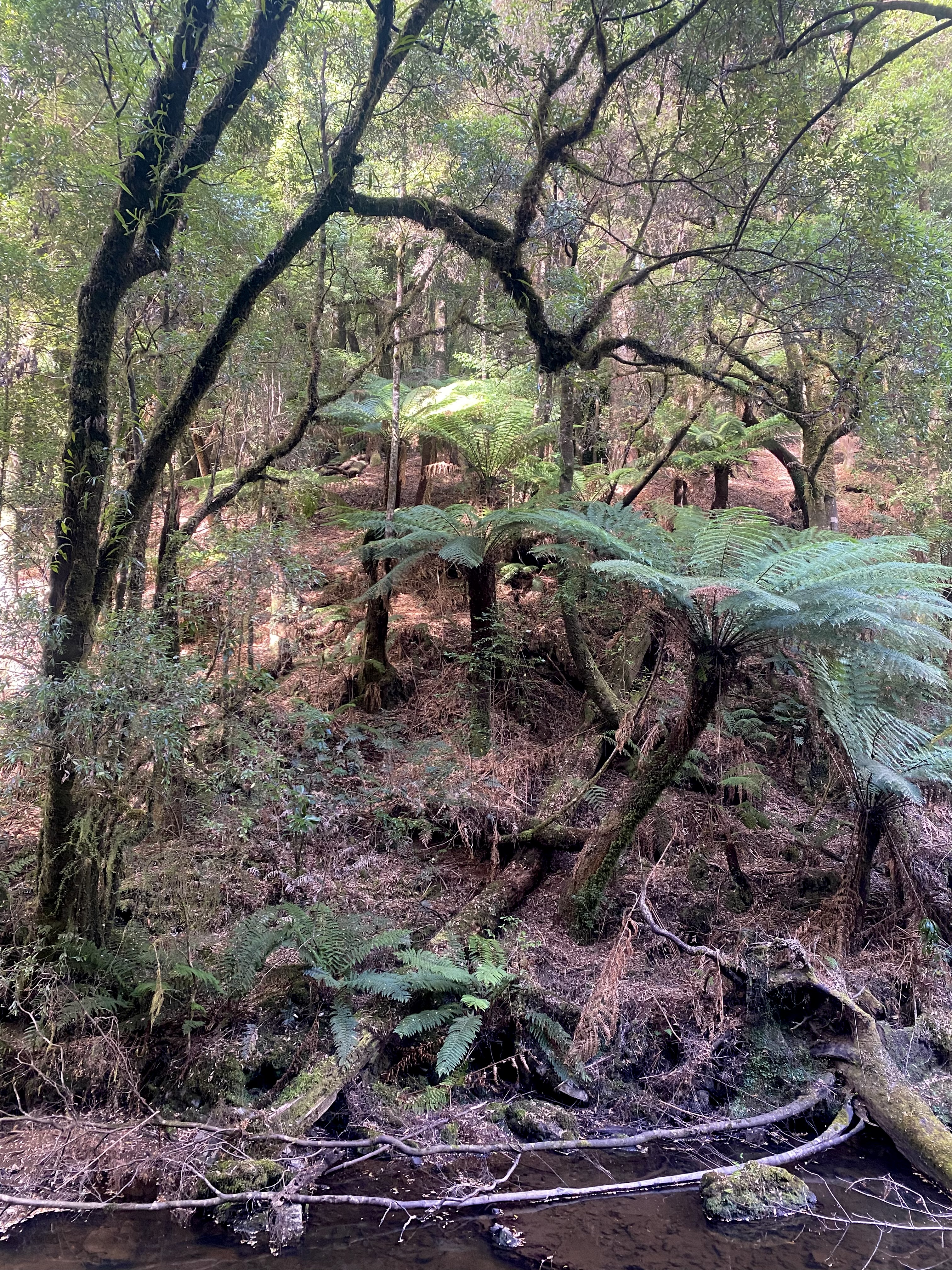
As I drive I think about the first of my uninformed reaction to the trees. I am a tree person and for me the more is the better, but, they are also a fire threat. The Gum trees are like instant firelighters and ignite with gusto, the undergrowth is dense so fire spreads easily. The evenings at the start of my trip was spent with my friend, Anka. She educates me. She has her suitcase packed in case she needs to do a quick getaway while her husband has decided to stay and protect the house he built himself. It is a stone house but the land all around them is tree covered, they live, as it were, in the forest.
‘Extreme bushfires have more than doubled in frequency and intensity over the past two decades, according to a global study from the University of Tasmania. Published in the journal Nature Ecology and Evolution, the research reveals that six of the past seven years have been among the most extreme on record for wildfires. “This study provides concrete evidence of a worrying trend”. “The intensity and frequency of these bushfires are increasing at an alarming rate, directly linked to the escalating effects of climate change” (Tasmania Times 25 June 2024)’.
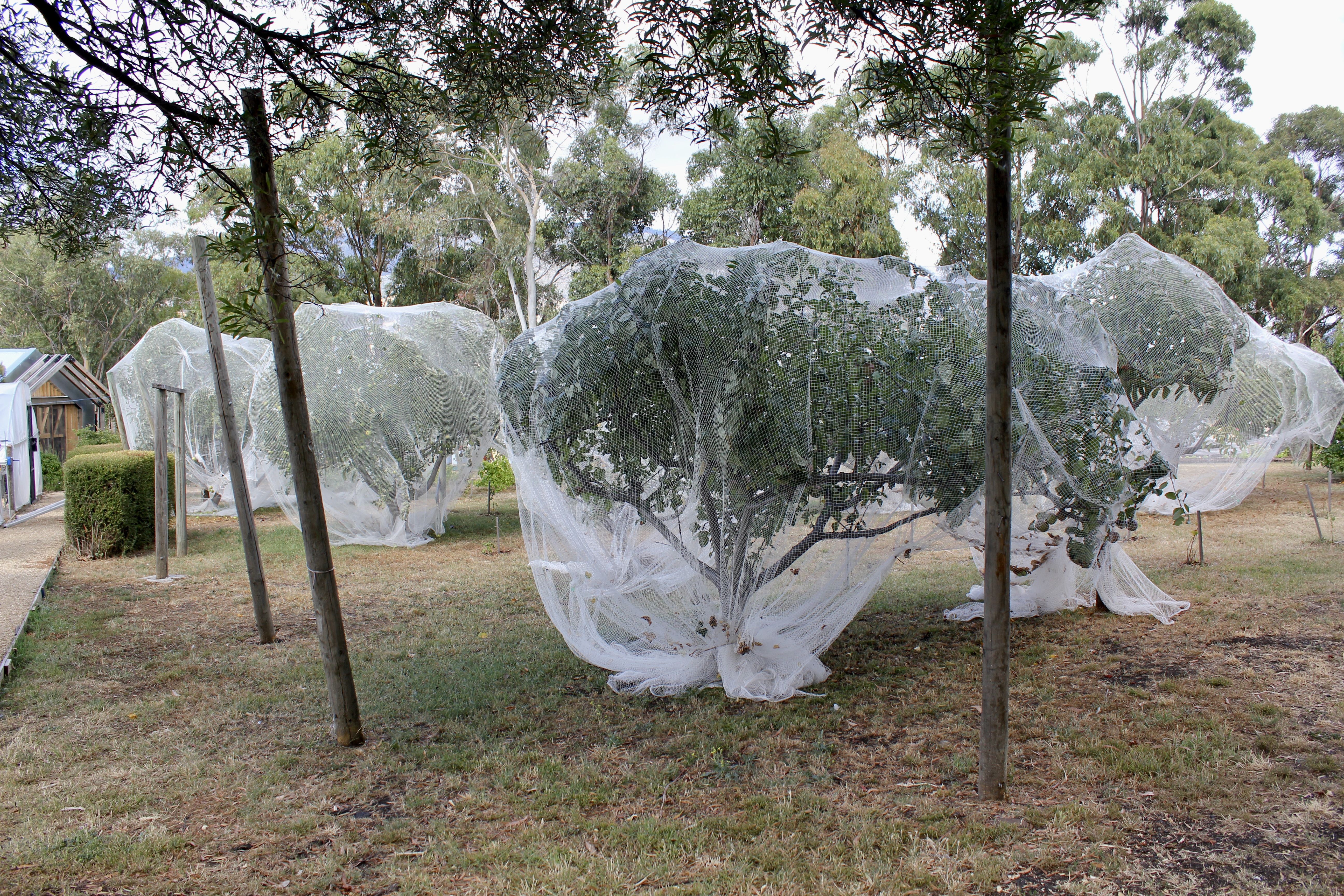
Here I am in a place so different from where I live. Here there are Bushfire preparation tips such as: ‘create or update your Bushfire plan’, ‘clear your property and prepare an emergency kit’, ‘know when to go and where to go’. It seems so far removed from the soothing forest I drive in, and yet, it is part of life here. I read about the current fire bans, the current fire danger ratings and the current, live bush fires. I am a tourist who is so unaware of one of the conditions of life here. I suddenly look at great expanse of trees as I drive, wondering if people have indeed heeded warnings and cleared their property and prepared an emergency kit. It is hard to think of these things when all I see is exceptional trees, giants with many years of growth and knowledge, vast fruit farms netted against birds and smiling happy, suntanned people who are going about their daily business.

The area where Anka lives now is “ripe for a fire”. There is still talk of the devastating fire of 2019. The trees here are older and bigger, the undergrowth dense and not managed. The indigenous Aboriginals who lived on this island knew how to keep the ground clear to the height of half of the tree height. This way the fire cannot jump. All this beauty of the trees is actually a scary, time bomb scenario. As a visitor you would not know this, you have to be informed by the locals. We walked up through the forest behind Anka and Dave’s house and pick tiny bush cherries off the bush tucker trees. Living here, on the side of a hill like this is so very different, it is a long way from their previous lives, in many ways. The water for drinking comes from the collected rain water and is stored in a large tank. The grey water for the house and garden comes from a collection point from a small creek up the hill which was dammed and slowly lets water down the hill to other water tanks as they need it. The electricity is solar power but they are also connected to the grid and sell their excess energy. Both with individual dietary preferences, they are a shining light of self sufficiency. Dave, a former chef, makes his own condiments, jams, wine, gin, tonic and so many more epicurean delights. Anka is a vegan but Dave is not and he often picks up roadkill to supplement his diet. There is a small vegetable patch and some fruit trees on a grassy area where they live and Dave spends much of his time clearing this to keep as large a space as possible between the forest and their house. They have no pets as, should a fire come, owners need to bring all that is required for their pets. The wildlife around them are their companion animals. I meet the wallabies in the evenings and hear the call of birds who’s songs I do not recognise. They sing and call all day long and into twilight and I don’t really want to find out what is out there after lights out. There is an us and them time and I am quite happy to adhere to that piece of advise.

14.02.2023. I stop at Sumac lookout which is a small raised platform looking out over a plain of grassland and the mighty Arthur River that makes me think of the plaines of mid America. Eagles soar here. The buttongrass fields are still covered in dew and there is a mist lingering on further away, low hills. It is full on snake season now so, again, I stomp as I walk and clap my hands.
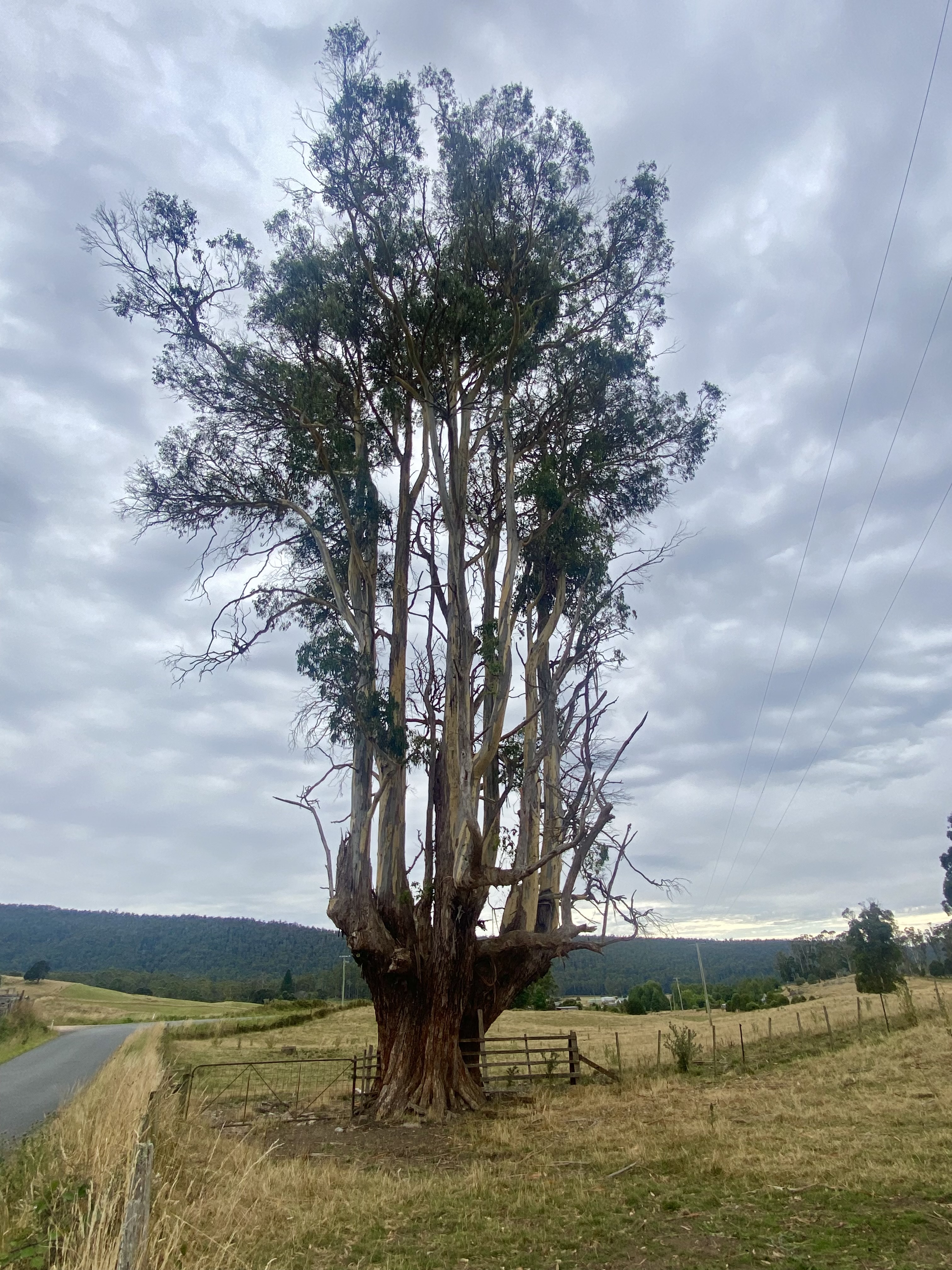
I pass over a bridge that spans the Arthur River. It’s sides are worn soft from past gushes of melt water and there are large trunks of trees and branches at the sides that have not made the trip down river last winter and spring. There is no one on the roads yet, I have not met a car since I left my camping place some hours ago. I drive this Tarkin drive slowly. Tarkin means ‘of the place’. Much to take in and to remember. Wild life around me hops out of the way at their own pace. They are slow but I am slower. Tasmanian chickens, small birds flashing green, others with illuminated plumage all just doing their thing. The sun is out now after a coldish night, an autumnal feeling is in the air and some trees are starting to drop their foliage. The finger shaped leaves of the eucalyptus cast their short shadows across the dash of the van in sunlight.
I see: garden escaped blue hydrangeas, flat farmland with irrigation, sienna earth, ocher earth, Edith Creek which is dry, herds of Black Angus, serious looking agricultural machinery, poppy fields, signs for ‘leave not trace’ and ‘ care for country’.

18.02.2023. I see: the Derwent river, An asylum turned into an art gallery, a community garden – completely open to anyone, a narrow gauge railway line along the river, two lads in a suped-up, navy blue, pick up truck – the number plate reads ‘peach’, rich looking brown soil, soft fruit dotted around in gardens, huge camper van that pass me as I go; are they coming or going? Wooden posts; weathered.
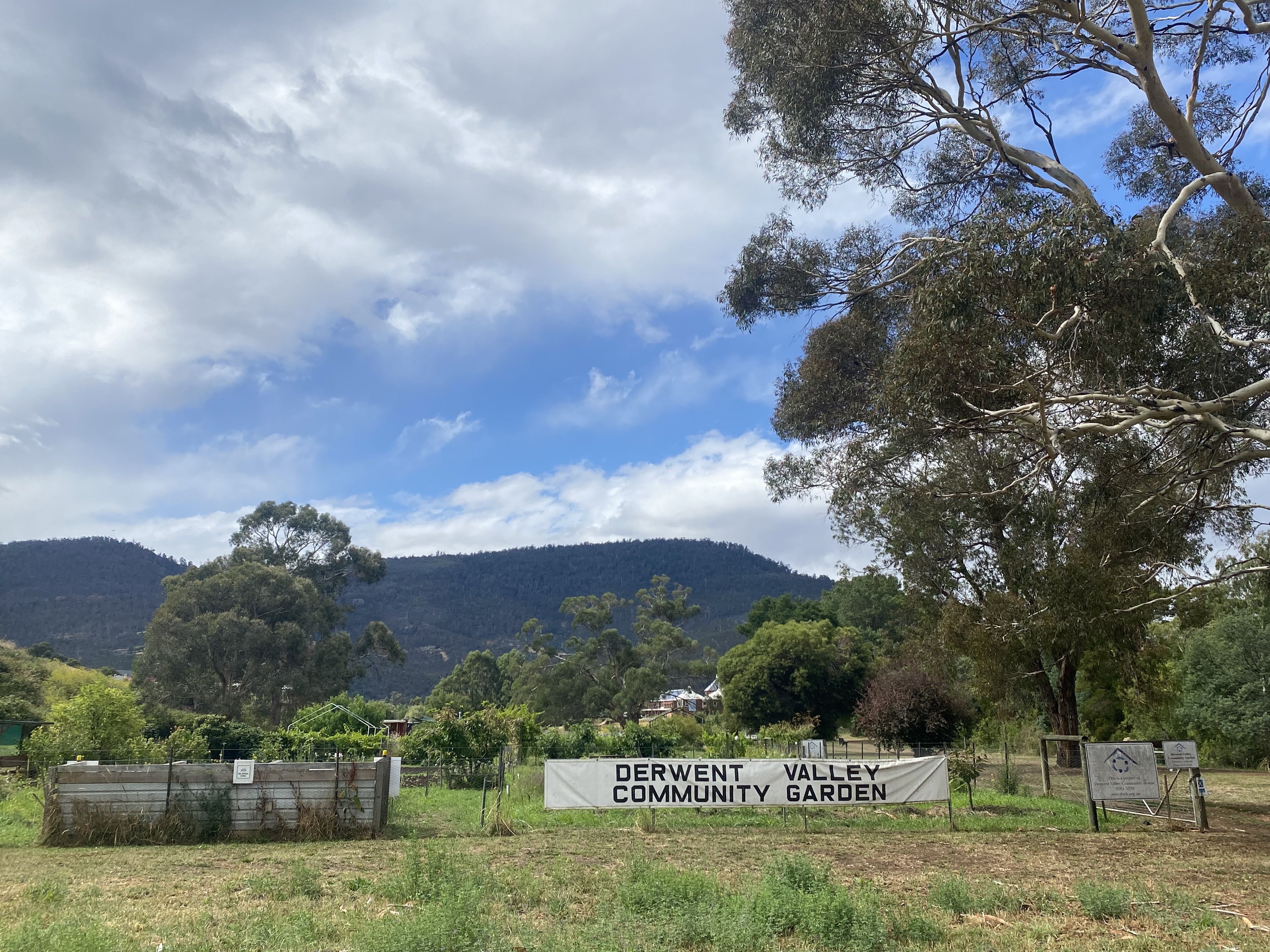
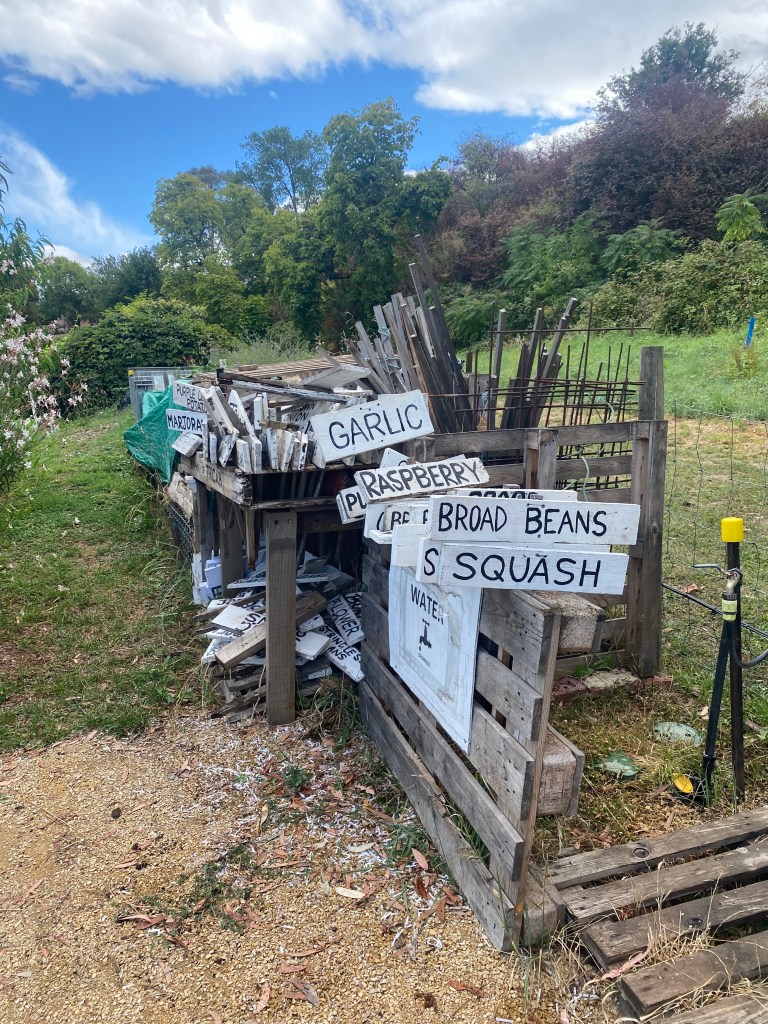
Derwent: it is here that I find the amazing community garden. A biggish town with an art community and many old buildings that were built, most likely, by convicts. The English vibe is back again. I visit the exhibition on show and then head for the community garden. It is impressively large and well taken care of. A pizza oven is even part of the amenities. There is a huge banner stating ‘Dewent Community Garden’ so that there can be no mistaking. The location is inviting as it sits on the floor of a little valley, surrounded by various trees and flowering bushes. Alas there are no gardeners present.

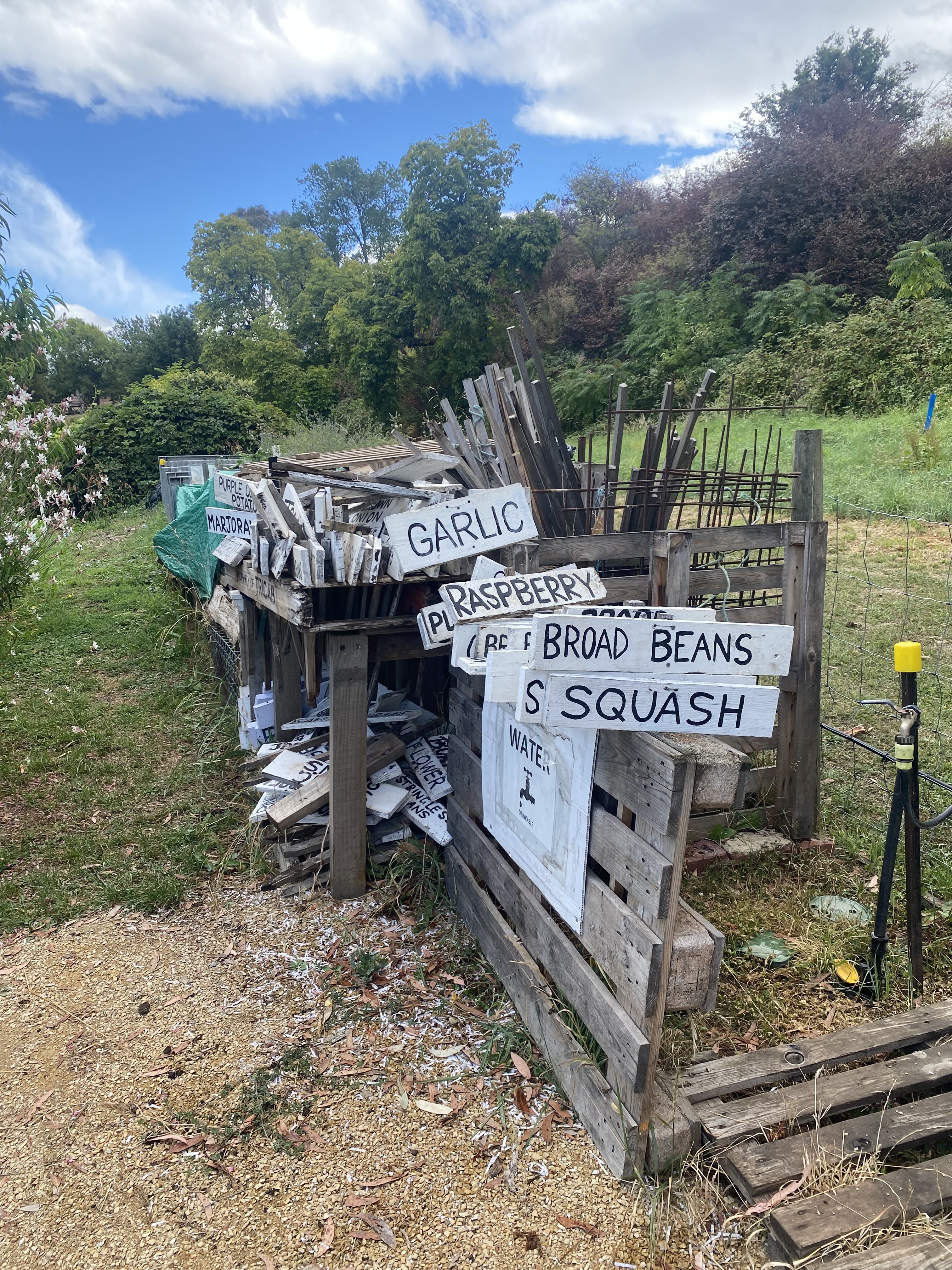
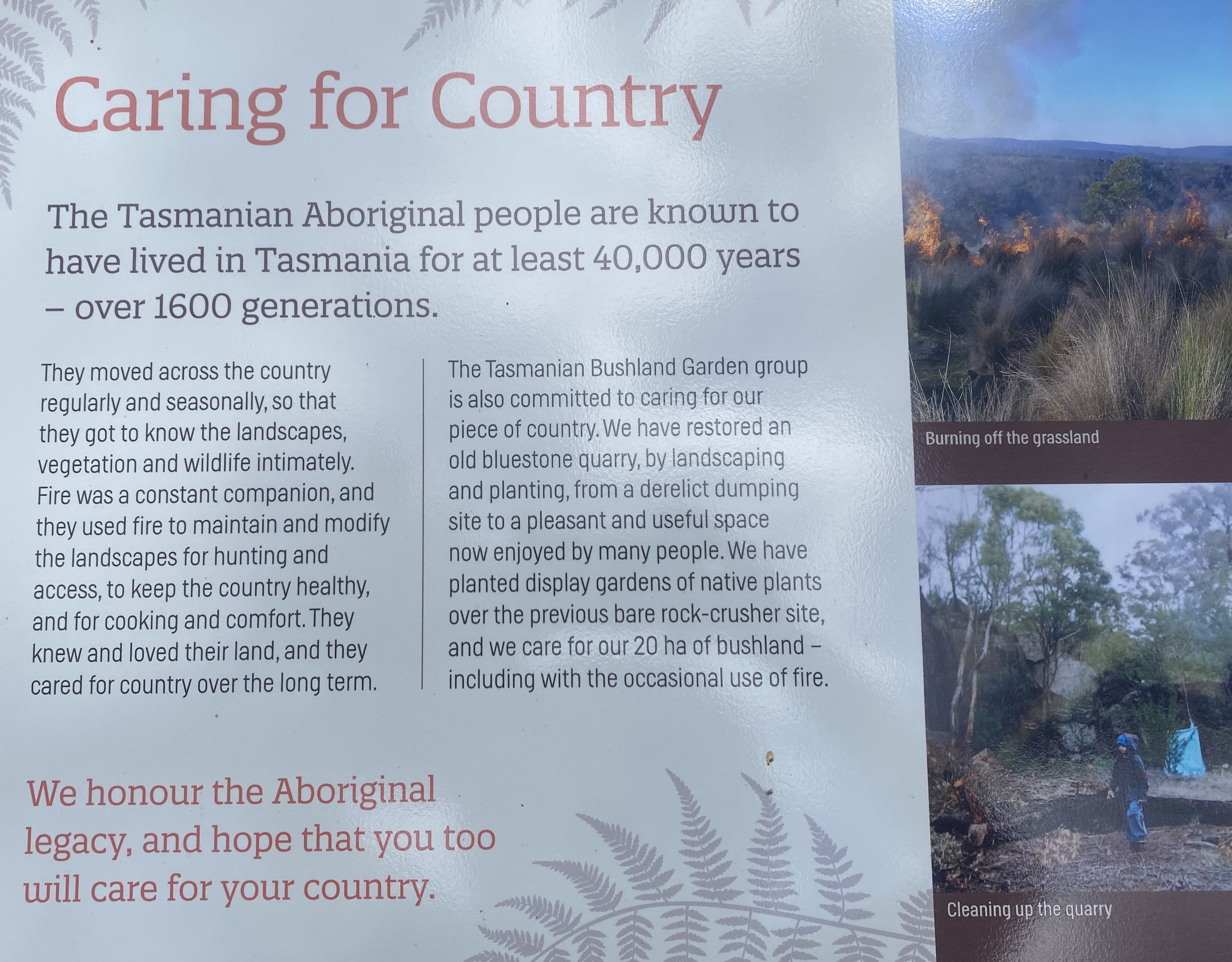
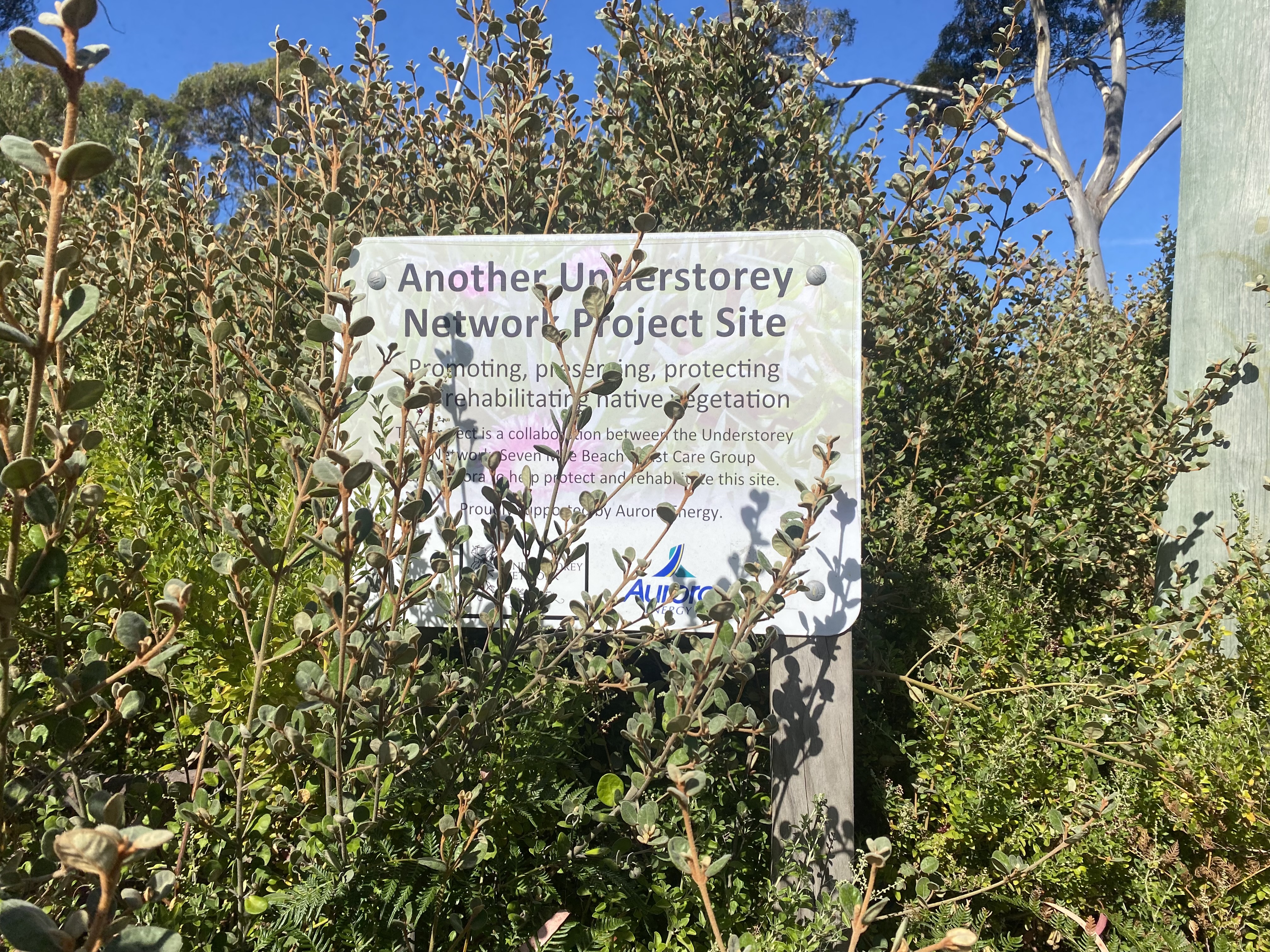
Blackhlls Road. Last night of camping.

I take this road because it tells me to. That unexplained feeling I have now when it is time to find a place for the night. The road goes up and up and it is absolutely stunning. A kind of summery of Tasmania – to the right are the eucalyptus forests, below the fields; cleared for farming and although now yellow/white in colour with dried grass, I throw in my imagination images of what they will look like when green and lush.
Thousands of acres for animal roaming – down the hill we go – fruit farms and the might of the Derwent river, it seems full now, but I can imagine it gushing in the rainy season – again, I assume/imagine. Windy on the hill, yes, but now a soft, warm wind. Down a boreen is an old farmhouse, a vernacular shaped house with the tin roof, protected by trees. New Norfolk is some 20 kms away. And I again think of the question Jo from ’24 Carrot’, asked me – If you were to live here, where would you live?
I slowly finish the last of my food and drink the last of the wine as my legs dangle from the back of the van so I can imprint this vista in my mind. I don’t know how else to take it with me. Photos are only a snapshot of a place, for me, it relates to a sense of land, a feeling of contentment.

I see: eagles, tall grass with fat seed heads – taller than the cows. Each side road has a name: Tom’s road, or Ben’s road or Rocky road, and at times no name at all. This road I am on is rough and as I hit the ‘big road’, it all feels too fast. The pushing and urgency of other vehicles, anxious to get where they are going. I pass through Bagdad and suddenly the constraints of time hit me. I must return this little house/van in a few hours.
And so I am at the small airport in Hobart and just an hour ago I was at the beach with Anke and her friend. The salt from the water is still on my legs and arms. The airport landing strips are so close to the two tone, blue, ocean water, where the hot underfoot sand is still on my boots. This tiny airport where arrivals and departures travellers mingle in the waiting area looks out on nothing much special but I know now what lies behind the dunes.

Derwent community garden
 ReplaceRemove
6,834 words, 36 minutes read time.
Last edited 5 minutes ago.
StatusPublished
PublishJuly 6, 2025 2:55 pm UTC+0
Slugtasmania
AuthorAnnabel Konig
TemplateDefault template
DiscussionClosed
Revisions
ParentNoneMove to trash
Writing Assistance
Write Brief (Beta)Show issues & suggestions
Optimize Title
Based on your post content and SEO best practices.Generate title options
Get Featured Image
Based on your post content.Generate image
Get Feedback
Get feedback on content structure.Generate feedback
Available Requests
20
Excerpt
Open save panel
- Page


 Annabel Konig - visual artist